
Engineering Specifications
Trading Steel for Titanium Without Losing the Tolerance
The Technical Challenge: Balancing Strength-to-Weight with Machining Stability
In high-speed industrial automation, the inertia of moving parts is the primary enemy of cycle efficiency. A leading robotics integrator required a set of six joint connectors that could withstand high torsional loads while significantly reducing the overall arm mass.
The choice of titanium (Ti-6Al-4V) presented significant machining hurdles. Titanium's low thermal conductivity and high work-hardening rate often lead to tool deflection and surface integrity issues. For these specific connectors, the internal bearing housings required a sub-micron cylindricity to ensure zero-backlash rotation over millions of cycles.
The Solution: Advanced 5-Axis Fabrication & DFM Optimization
By leveraging simultaneous 5-axis machining centres, we eliminated multiple setups, which is critical for maintaining the complex geometric relationships between the joint's pivot points.
- Tooling Strategy: we utilised specialised AlCrN-coated carbide cutters and high-pressure through-spindle coolant to manage heat dissipation, preventing micro-cracking in the titanium grain structure.
- DFM Integration: our engineering team optimised the internal radii of the connectors, reducing stress concentration points by 22% while streamlining the tool path for faster cycle times without compromising rigidity.
- Thermal Stability Control: machining was conducted in a climate-controlled environment to mitigate material expansion, ensuring that the critical tolerances of ±0.005 mm were maintained throughout the batch production.
The geometric complexity of these titanium connectors left no room for error. Their technical team not only delivered the precision we required but also provided the material traceability necessary for our high-load automation standards.
Lead Systems Architect, robotics integrator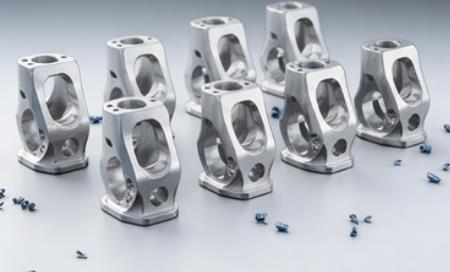
The Results: Reliable Delivery & Performance Excellence
The transition from legacy steel components to 5-axis machined titanium connectors resulted in immediate operational gains for the client:
- Mass Reduction: achieved a 40% reduction in joint weight compared to stainless steel, allowing for a 15% increase in peak acceleration speeds.
- Zero-Backlash Performance: precision boring of bearing seats ensured a perfect interference fit, eliminating vibration-induced wear during high-cycle operations.
- Verified Reliability: every component was delivered with a comprehensive Zeiss CMM report and ultrasonic flaw detection results, ensuring 100% “plug-and-play” reliability on arrival.
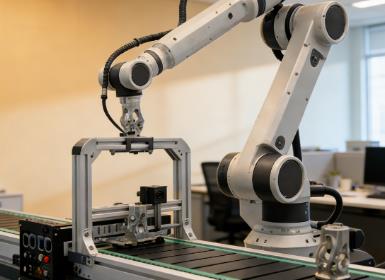
With these high-performance links, the client successfully deployed a new generation of robots capable of 24/7 operation in high-precision assembly lines. Our ability to handle difficult-to-machine alloys like titanium with extreme accuracy has established a new benchmark for their automation hardware supply chain.
The geometric complexity of these titanium connectors left no room for error. Their technical team not only delivered the precision we required but also provided the material traceability necessary for our high-load automation standards.Lead Systems Architect, robotics integrator
Ready to Optimize Your Automation Hardware?
From titanium kinematic links to hardened steel drive housings, we provide the precision engineering required for next-generation robotics.